¶ Manual partitioning
Use manual partitioning when you need a layout the installer's automatic
options don't create: a custom size, a second drive, or keeping an existing
EFI partition shared with another operating system. If you just want Nobara on
a whole disk, Erase disk is simpler and creates a supported layout for you.
This guide covers the two layouts Nobara's updater can roll back if an update
fails:
- Btrfs root, the most common choice.
- ext4 on LVM, for people who prefer ext4 (XFS on LVM
works the same way).
A plain ext4 or XFS root partition (without LVM) still installs and gets
updates, but the updater can't roll it back if an update fails.
Partitioning deletes data. Back up anything you want to keep before you
start. Nothing is written to disk until you click Install on the Summary
page, so you can always go back and click Revert All Changes.
¶ What every layout needs
| Partition | Size | File system | Mount point | Flags | Why |
|---|---|---|---|---|---|
| EFI system partition | 600 MiB | fat32 | /boot/efi |
boot |
Firmware boot files (UEFI systems) |
| Boot | 2 GiB (2048 MiB) | ext4 | /boot |
none | Kernels and initramfs |
| Root | rest of the disk | Btrfs, or LVM (see below) | / |
none | The system |
- Use a disk of at least 32 GiB. A fresh install uses about 20 GiB, and
updates need room to download and install. - Use a GPT partition table. UEFI systems need it.
- Keep
/bootas its own ext4 partition. Update rollback restores the
system from a snapshot, and the boot files must live outside that snapshot.
Without a separate/boot, updates still install, but automatic rollback is
unavailable. - The EFI partition mounts at
/boot/efi, not/boot. 600 MiB is the
recommended size. (Older installers' hint says "fat32 512Mb /boot
partition"; ignore it and use/boot/efi.) - Already have Windows or another Linux? Don't create a second EFI
partition. Select the existing one, click Edit, set the mount point to
/boot/efi, and leave Keep selected so it isn't formatted. - Swap is optional. Nobara uses compressed RAM swap (zram) by default. If
you want disk swap, use a swap partition (or a swap LV on LVM). Don't add a
swap file inside the Btrfs root subvolume later: the updater won't prepare
system updates until it's moved to its own subvolume.
¶ Starting manual partitioning
- Boot the Nobara live USB and open Install Nobara.
- Fill in the Welcome, Location, Keyboard and Users pages.
- On Partitions, check the top bar shows EFI (UEFI mode) and pick the
disk under Select storage device. - Select Manual partitioning and click Next.
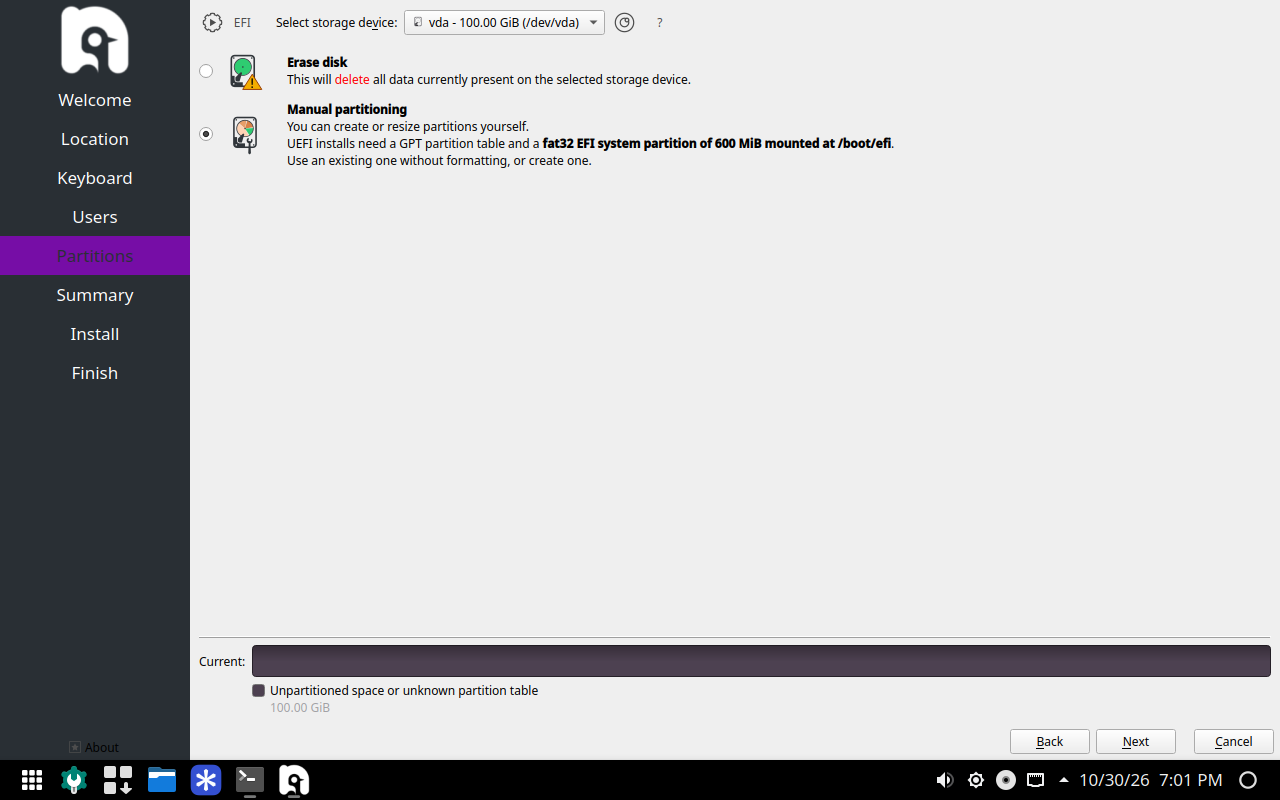
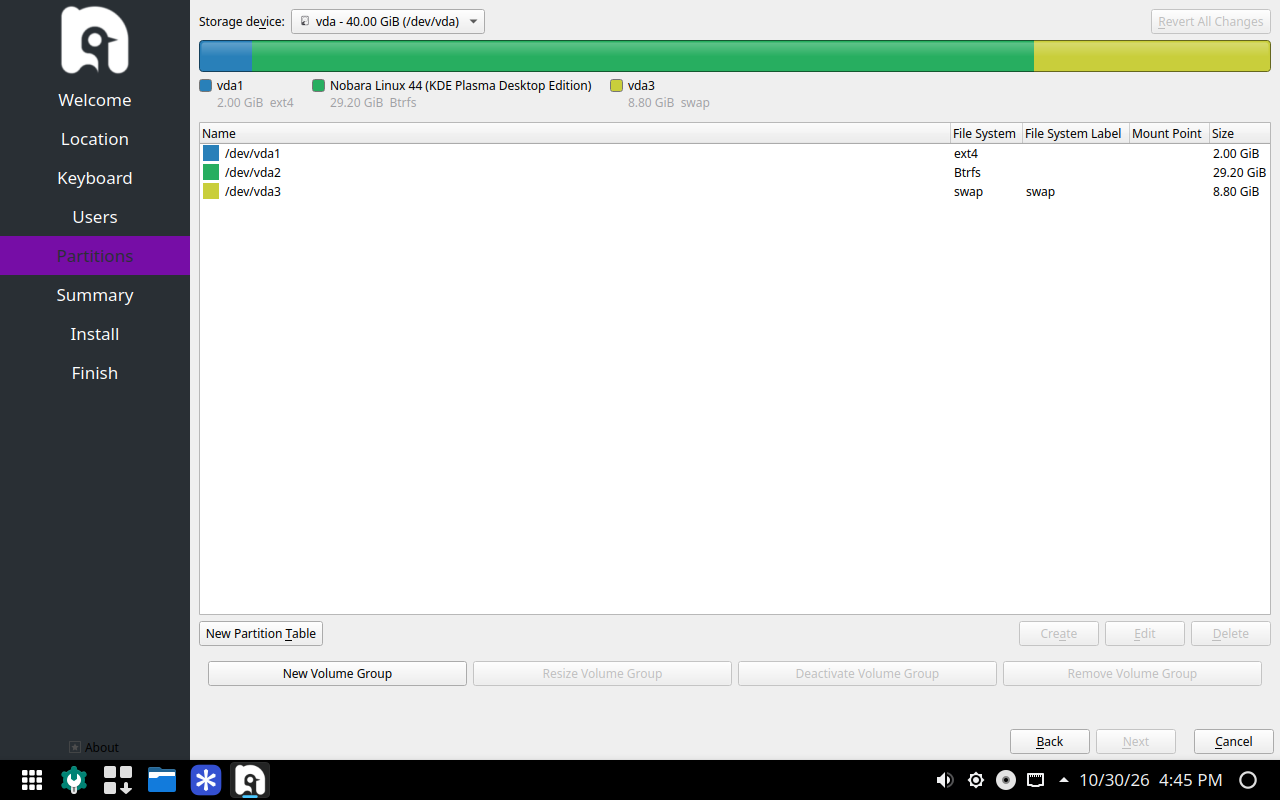
The partition editor shows the disk's current layout.
¶ Start with an empty disk
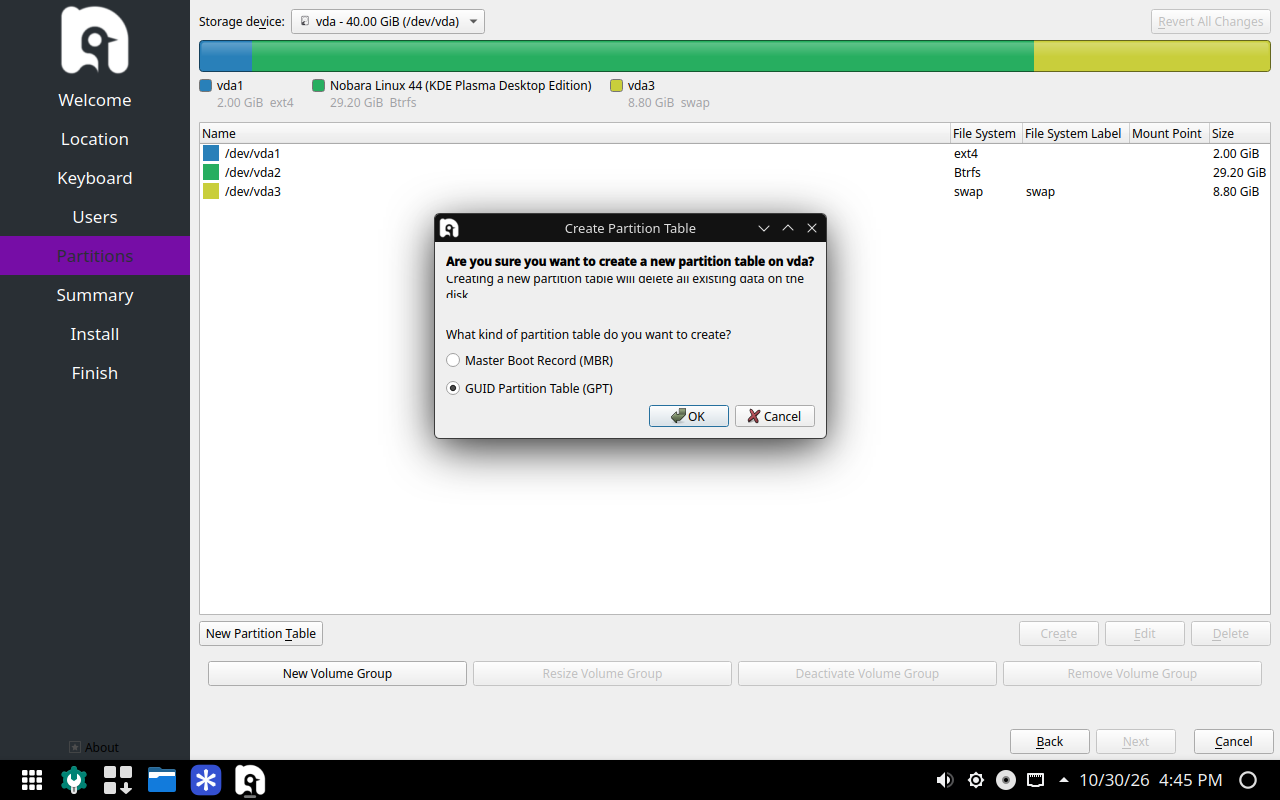
If you're using the whole disk, click New Partition Table, choose
GUID Partition Table (GPT) and click OK. This removes every partition
on that disk.
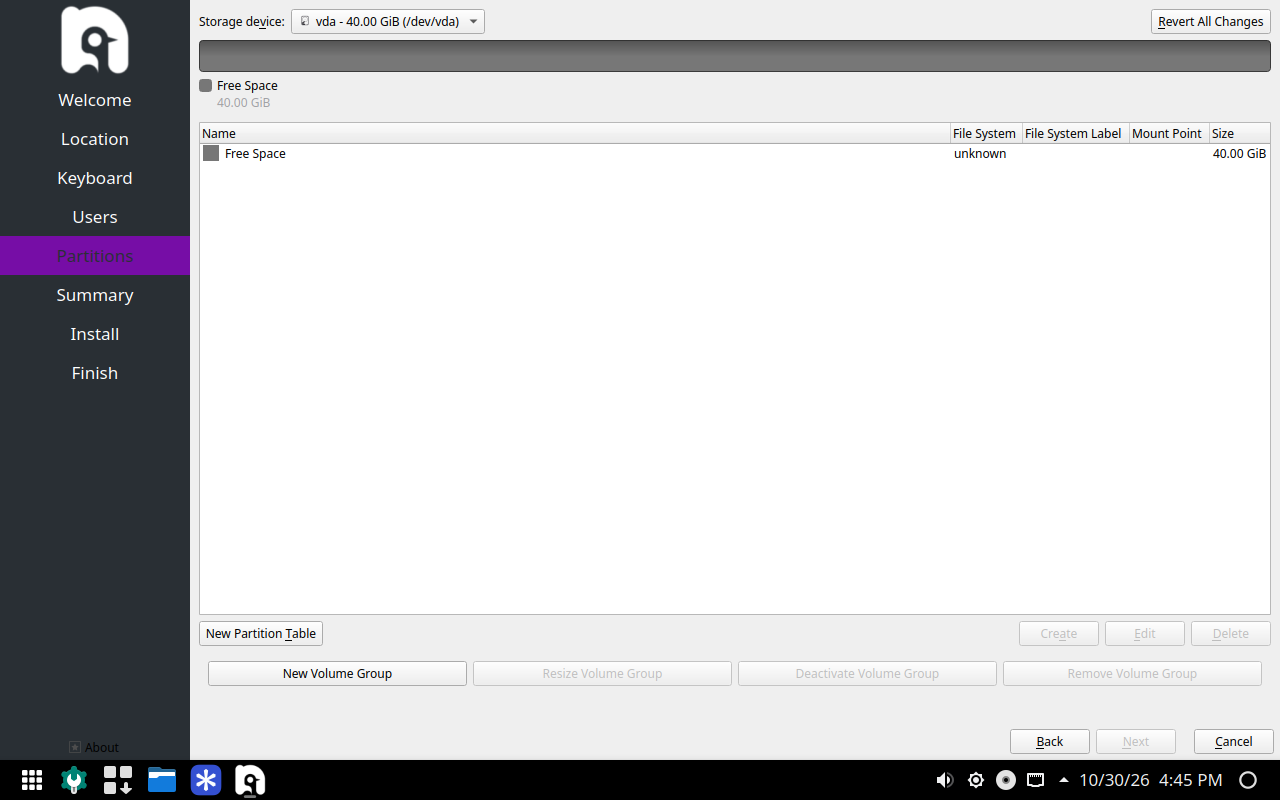
The disk is now one block of Free Space.
If you're keeping other partitions, skip this and delete only the partitions
you're replacing, or use existing free space.
¶ Create the EFI system partition
Select Free Space and click Create.
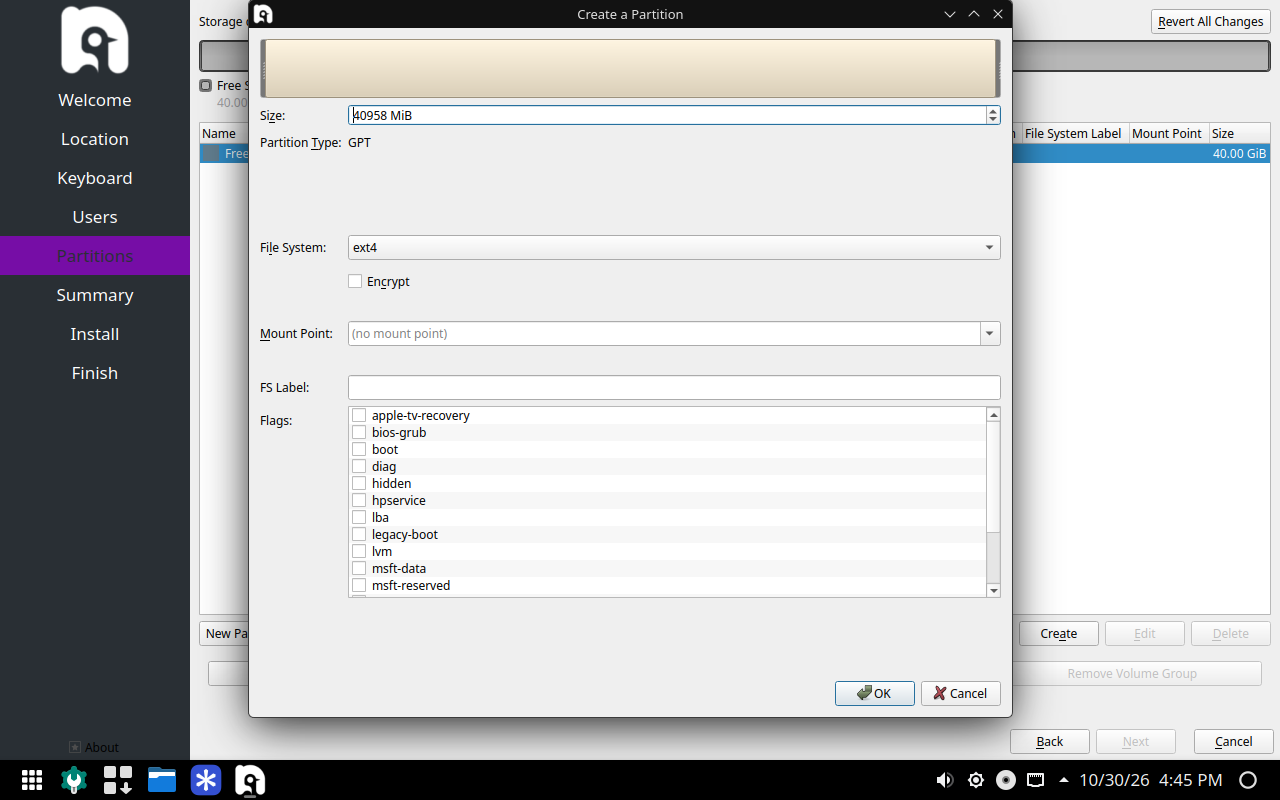
| Field | Value |
|---|---|
| Size | 600 MiB |
| File System | fat32 |
| Mount Point | /boot/efi |
| FS Label | EFI (optional) |
| Flags | tick boot |
Click OK.
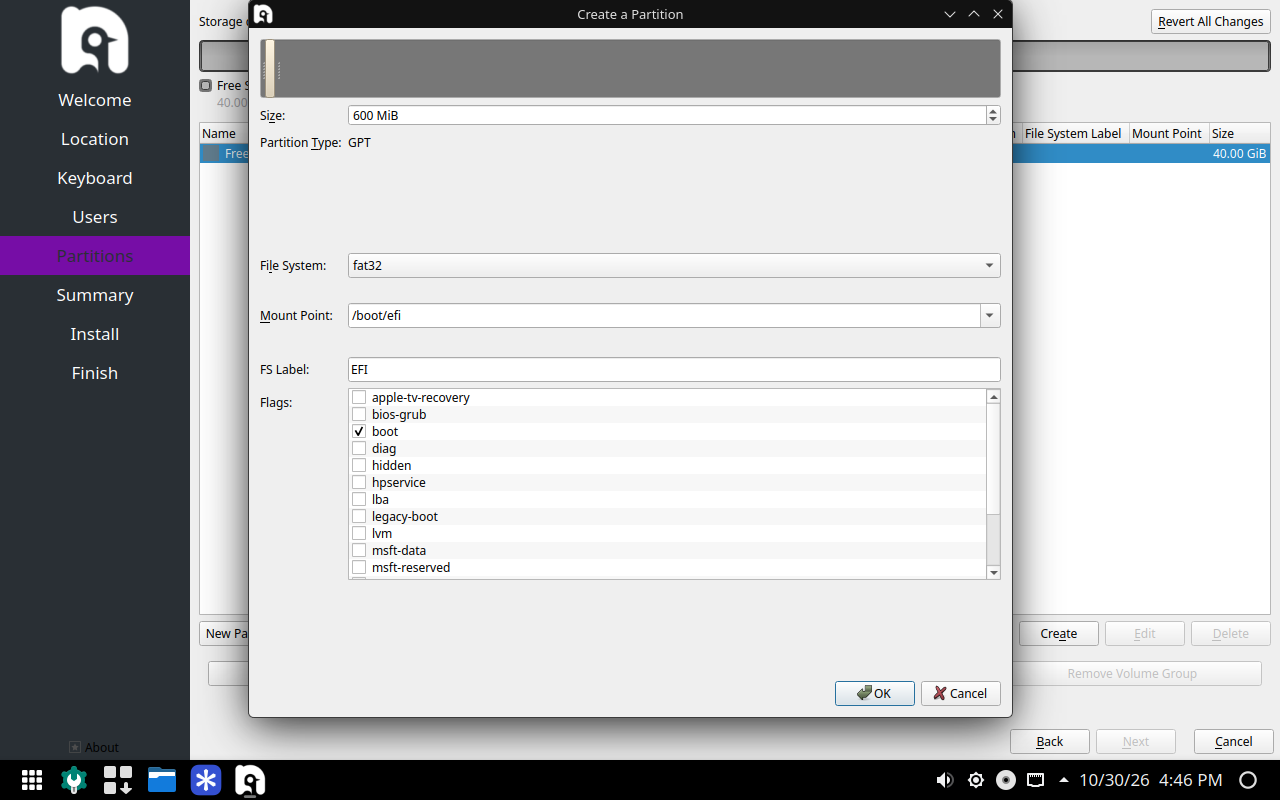
¶ Create the /boot partition
Select the remaining Free Space, click Create, and enter:
| Field | Value |
|---|---|
| Size | 2048 MiB |
| File System | ext4 |
| Encrypt | leave unticked |
| Mount Point | /boot |
| FS Label | boot (optional) |
| Flags | none |
Click OK.
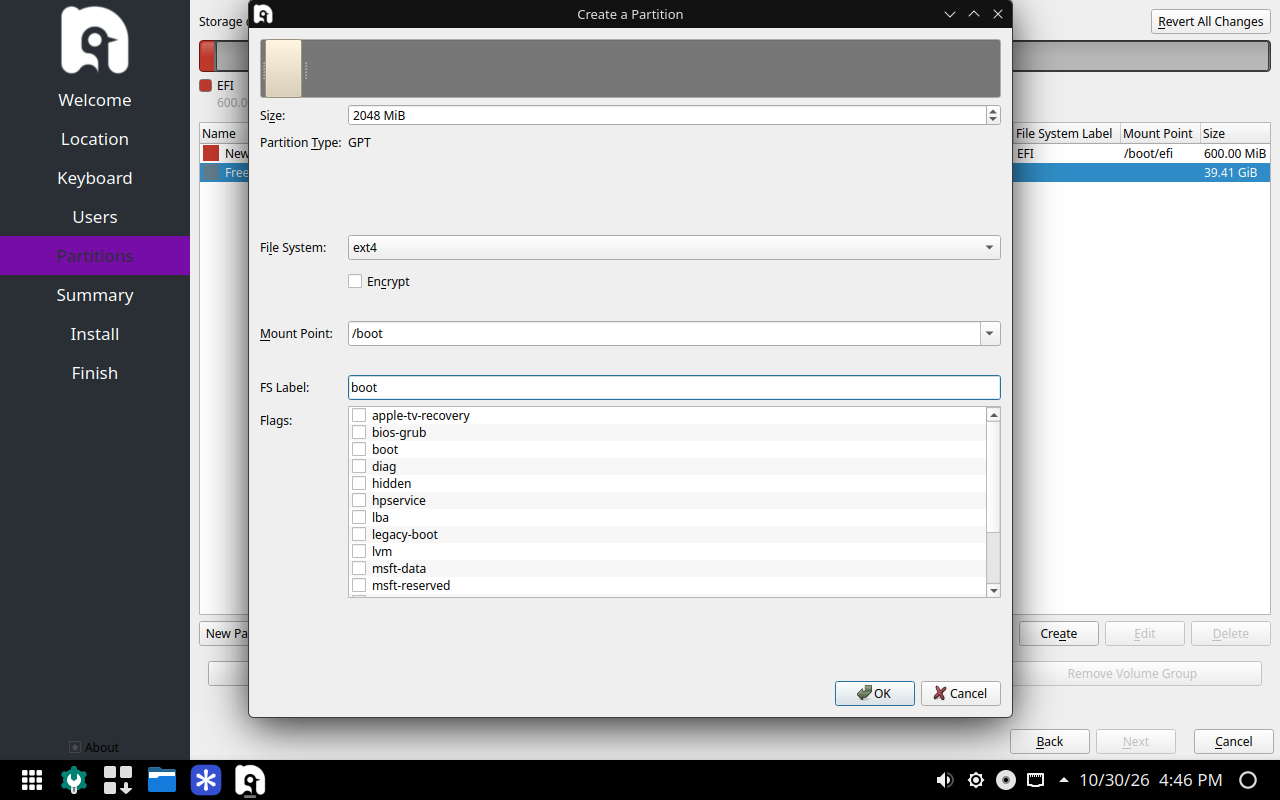
¶ Now continue with either
ext4 root in LVM
or
Btrfs root
¶ ext4 root in LVM
Manual LVM needs an installer with Calamares 3.3.14-139 and
kpmcore 26.08.1-1.nobara or newer. Older installers crash or discard your
changes when you create the volume group. On an older ISO, use Erase disk
and choose ext4 on LVM instead.
With LVM you create one large partition (a physical volume), group it into a
volume group, and then create logical volumes for / and /home inside
it.
¶ Plan your sizes first
Update rollback takes a snapshot of the root logical volume, and that snapshot
needs unallocated space in the volume group at least as large as the root
logical volume, plus 5%. Leave that space empty; the updater uses it during
each system update and frees it again afterwards.
| Logical volume | Size | Notes |
|---|---|---|
root (/) |
at least 40 GiB; 64–100 GiB is comfortable | The system and its applications (a fresh install is already about 20 GiB) |
home (/home) |
what's left after the free space below | Your files and games. Must be separate from root |
| (left unallocated) | root size + 5% | Rollback snapshot space |
swap |
optional | Only if you want disk swap |
For example, on a 1 TB disk: a 100 GiB root, 106 GiB left free, and about
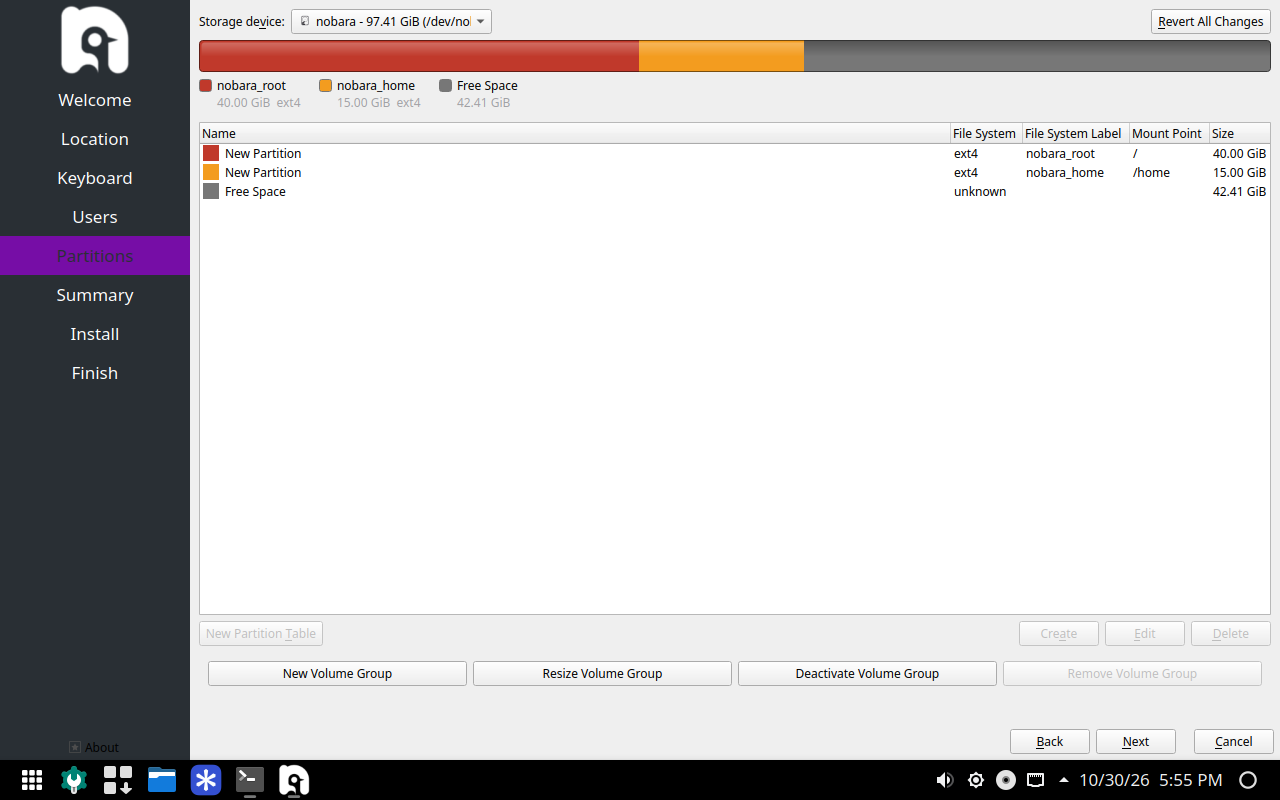
720 GiB for home. The LVM screenshots below use a 100 GB test disk: a 40 GiB
root, a 15 GiB home and 42.4 GiB left free.
Because the volume group must keep about as much free space as the root
volume, a rollback-capable LVM layout needs a disk of roughly 100 GB or more.
On smaller disks, use Btrfs instead.
If the free space is too small, updates still install, but without automatic
rollback. The update log says "Automatic rollback is unavailable" and how much
volume group space is needed.
¶ Create the physical volume
After creating the EFI and /boot partitions, select the remaining
Free Space, click Create, and enter:
| Field | Value |
|---|---|
| Size | leave the default (all remaining space) |
| File System | lvm2 pv |
| Mount Point | none (greyed out) |
Click OK.
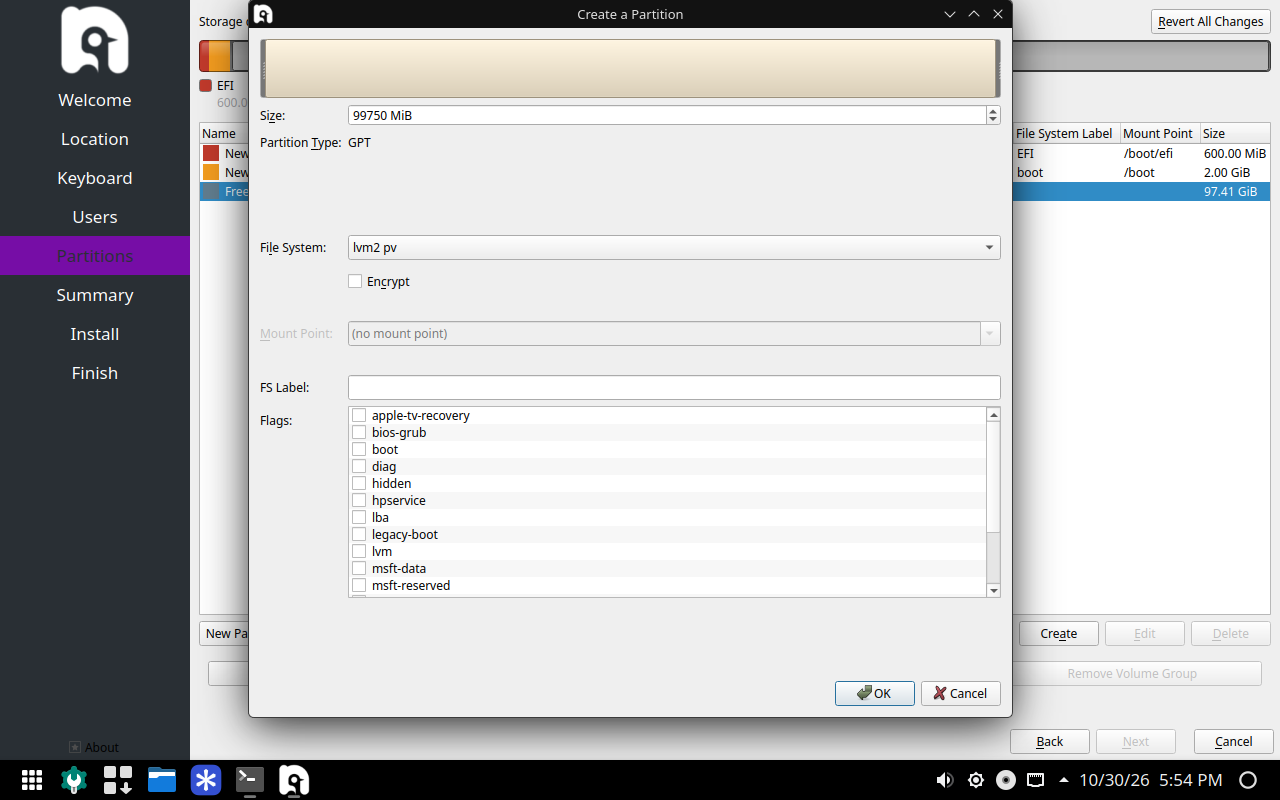
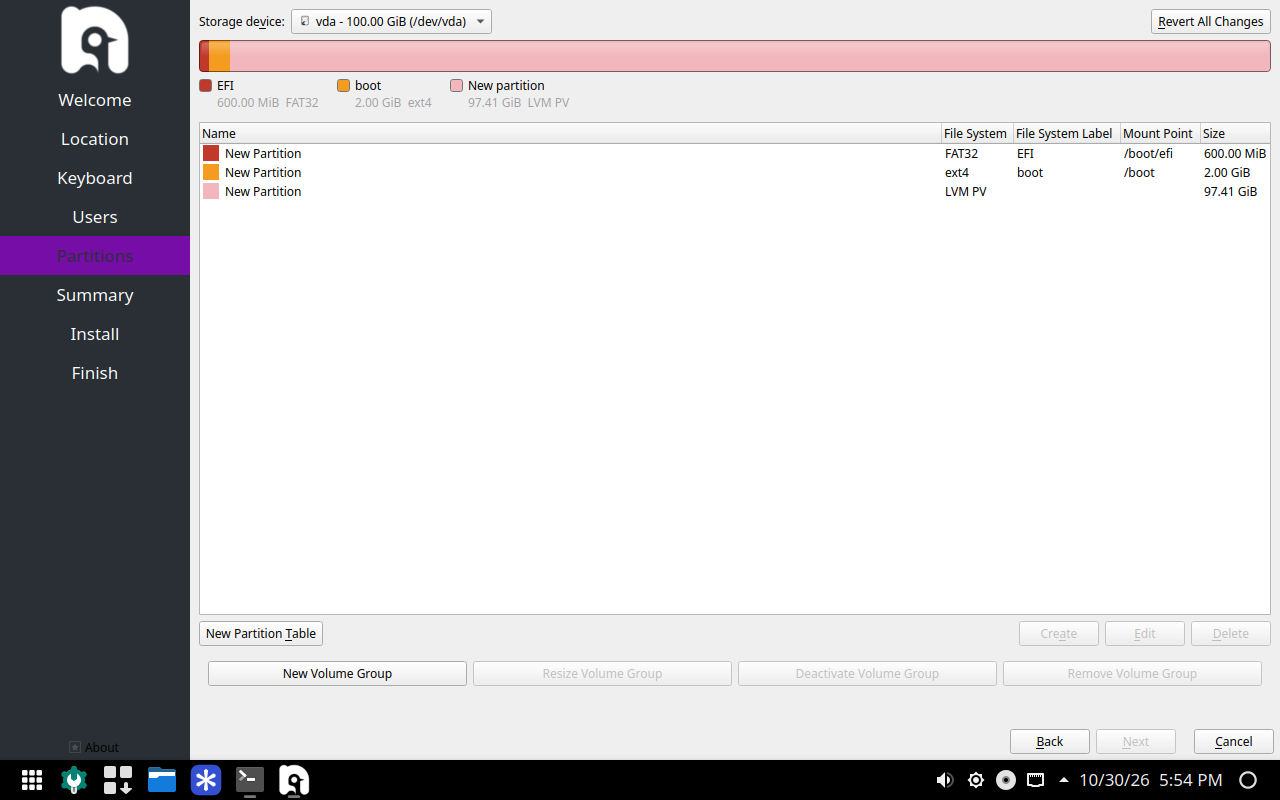
The disk now has the EFI partition, /boot, and an LVM PV.
¶ Create the volume group
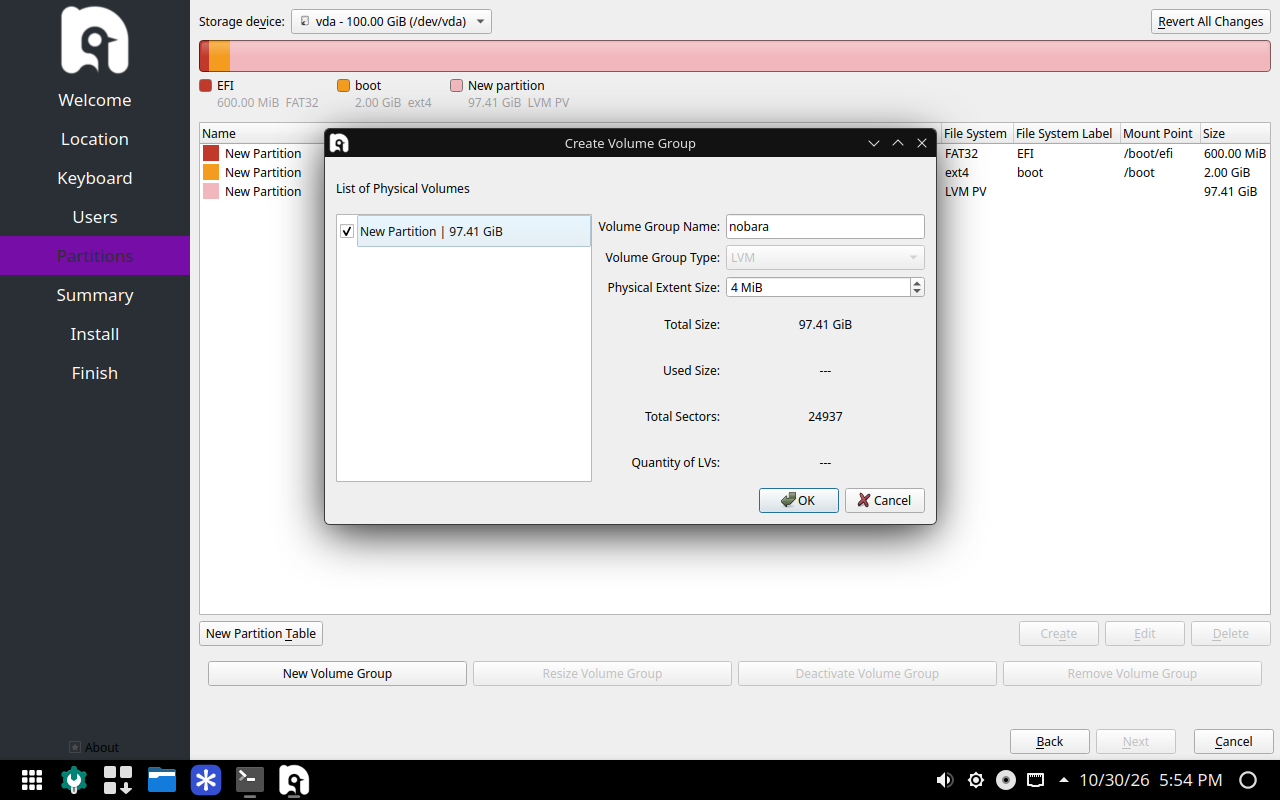
Click New Volume Group. Enter a Volume Group Name (this guide uses
nobara), tick the physical volume you just created, leave Physical Extent
Size at 4 MiB, and click OK.
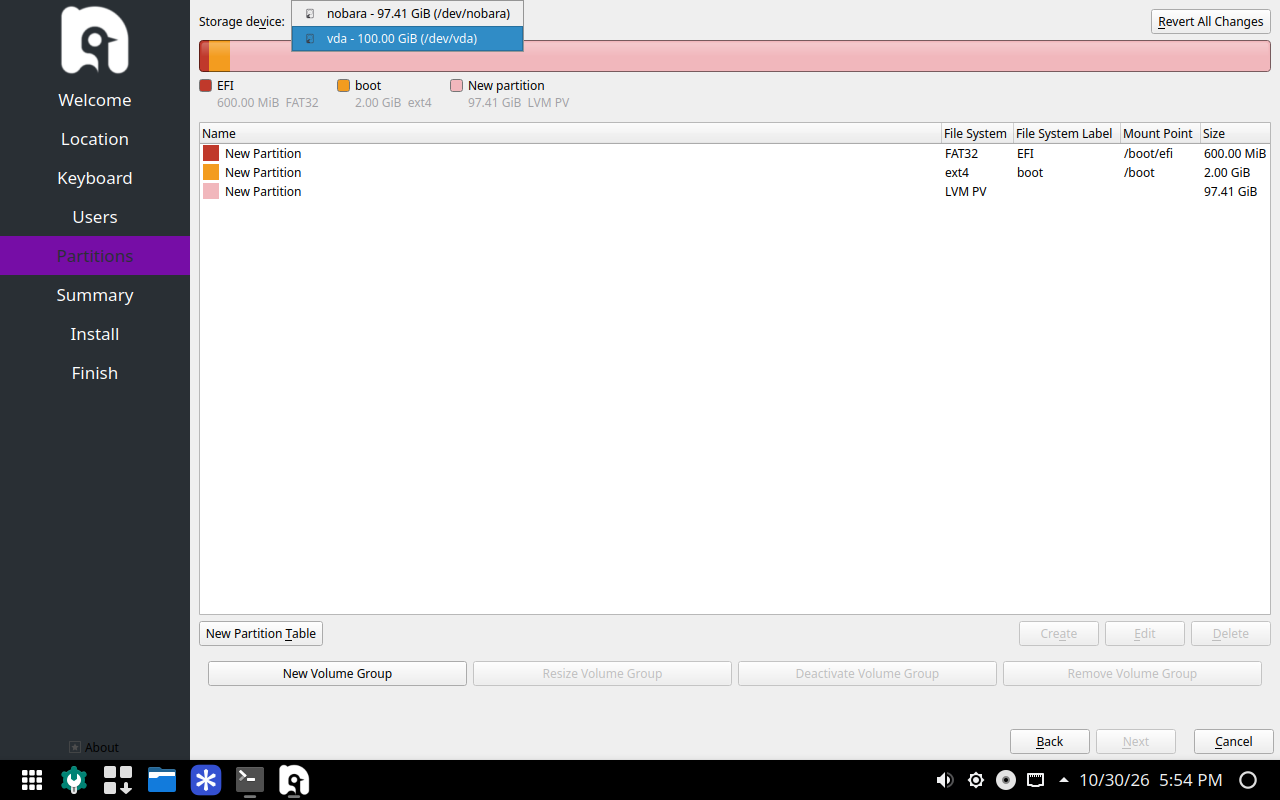
The view stays on your disk. Open the Storage device list at the top and
select the new volume group.
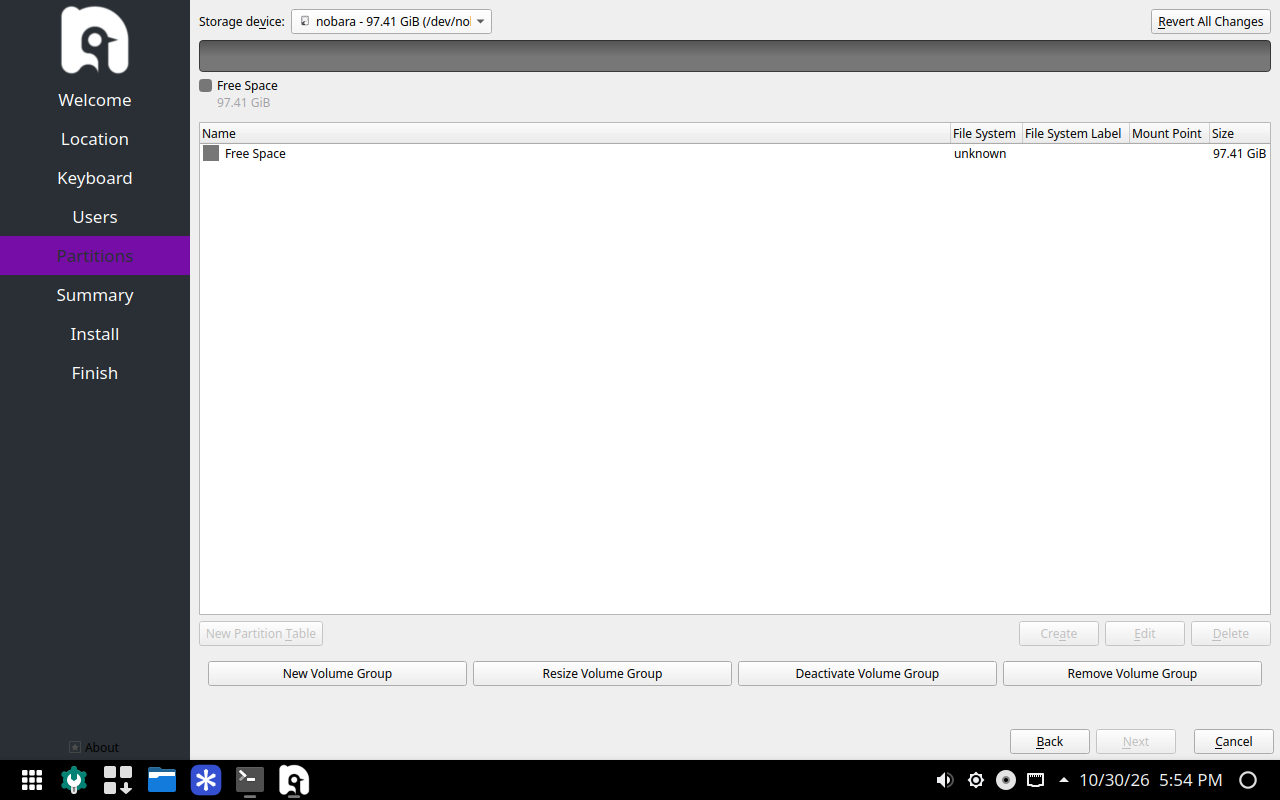
The volume group starts as one block of free space.
¶ Create the root logical volume
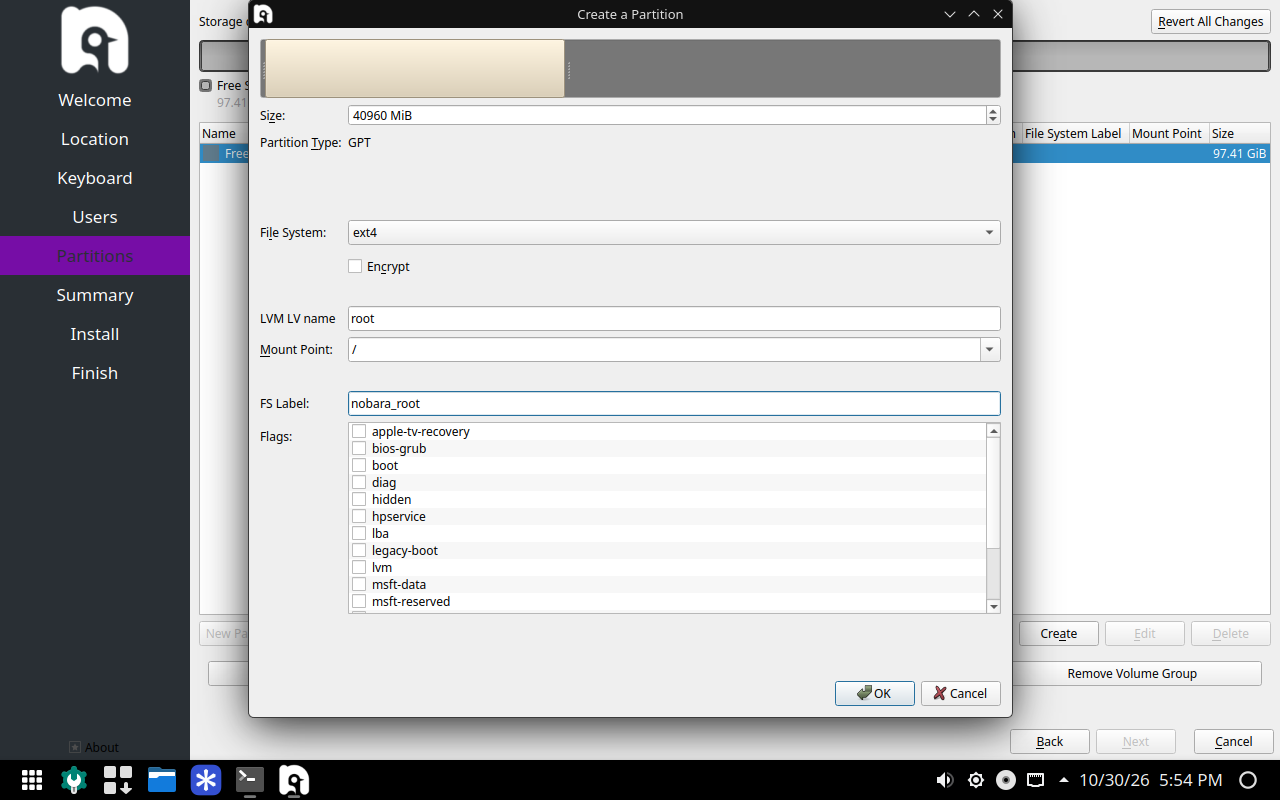
Select Free Space, click Create, and enter:
| Field | Value |
|---|---|
| Size | your root size, e.g. 40960 MiB for 40 GiB |
| File System | ext4 (or xfs) |
| Encrypt | leave unticked |
| LVM LV name | root |
| Mount Point | / |
| FS Label | nobara_root (optional) |
Click OK.
¶ Create the home logical volume
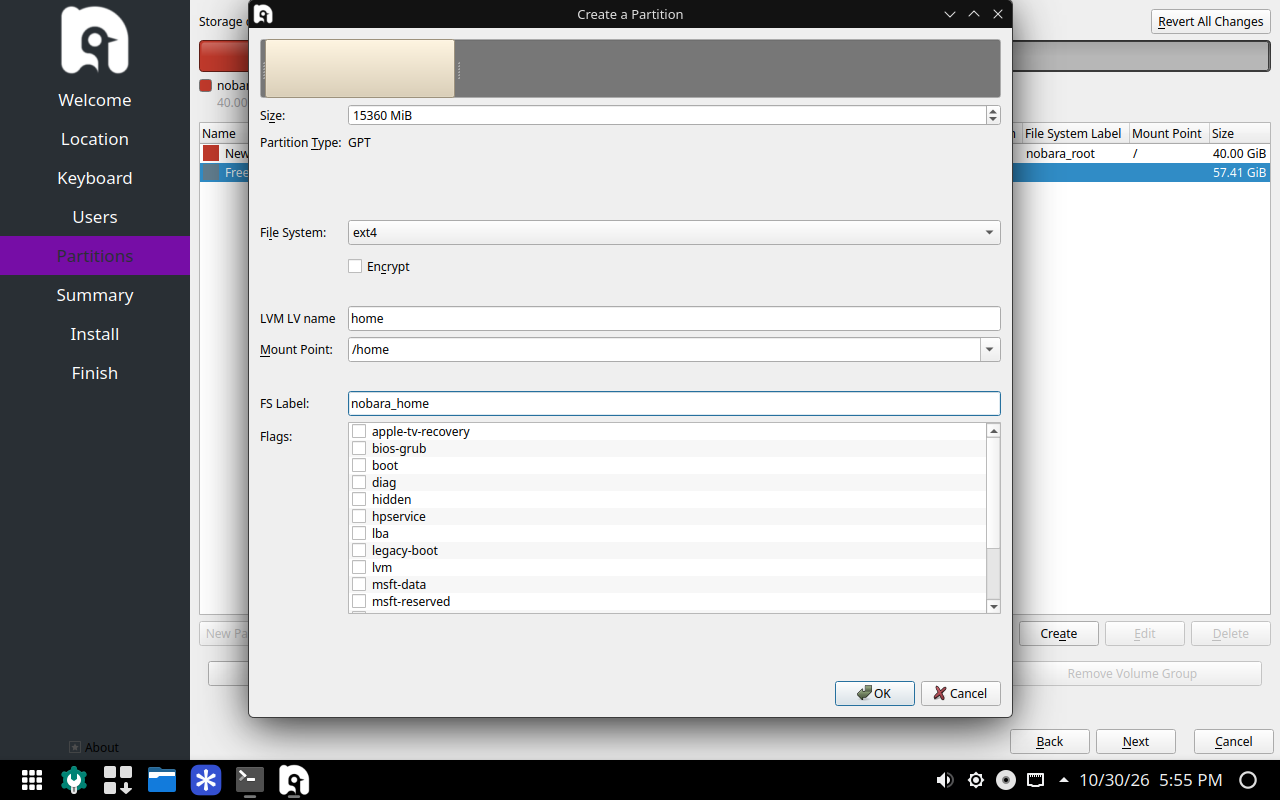
Select Free Space again, click Create, and enter:
| Field | Value |
|---|---|
| Size | total free space minus the rollback space from your plan |
| File System | ext4 (or xfs) |
| LVM LV name | home |
| Mount Point | /home |
| FS Label | nobara_home (optional) |
Click OK.
Don't create anything in the remaining free space. It's the rollback
space.
¶ Check the summary
Click Next. The Summary page shows both the disk and the volume group:
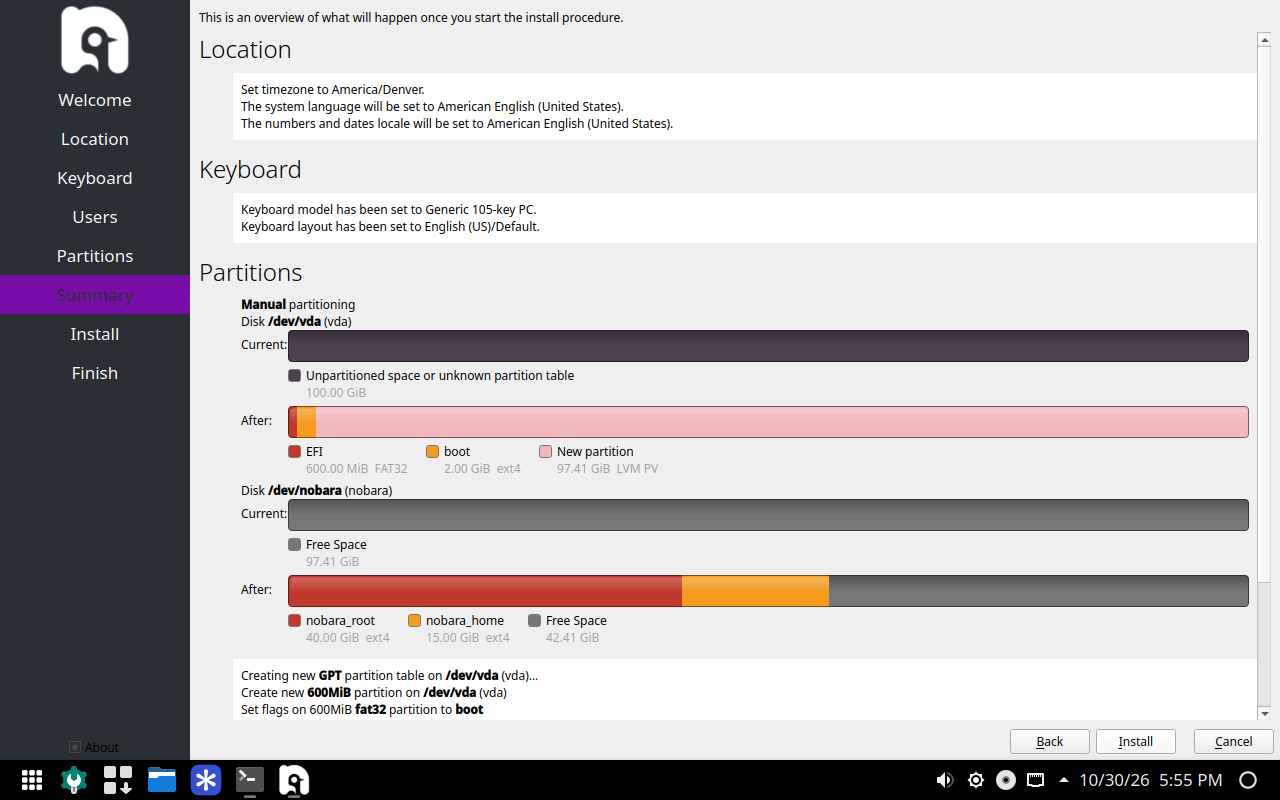
The list of operations should include creating the volume group, the root and
home logical volumes, and "Install Nobara Linux on ext4 system partition
/dev/your-vg/root".
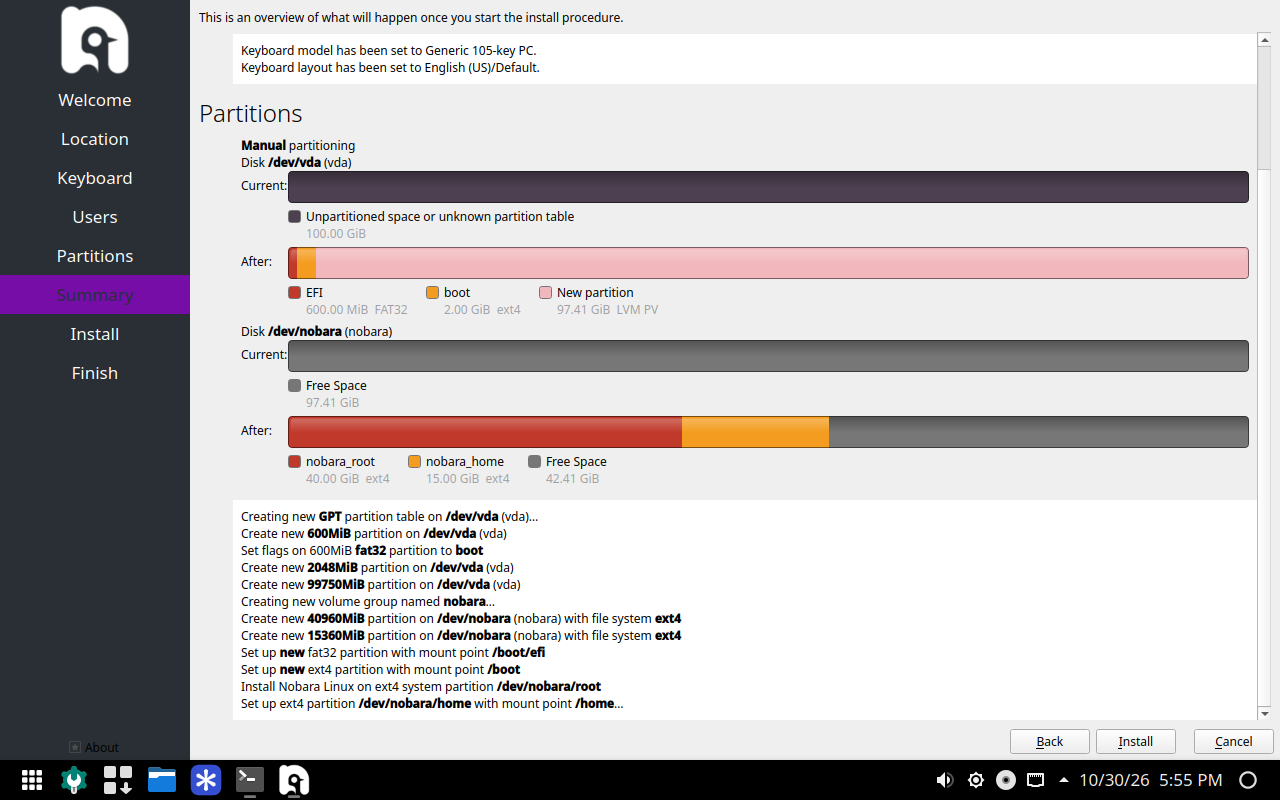
If it looks right, click Install.
¶ Btrfs root
Select the remaining Free Space, click Create, and enter:
| Field | Value |
|---|---|
| Size | leave the default (all remaining space) |
| File System | btrfs |
| Encrypt | optional; tick it for full-disk encryption and set a passphrase |
| Mount Point | / |
| FS Label | nobara (optional) |
| Flags | none |
Click OK.
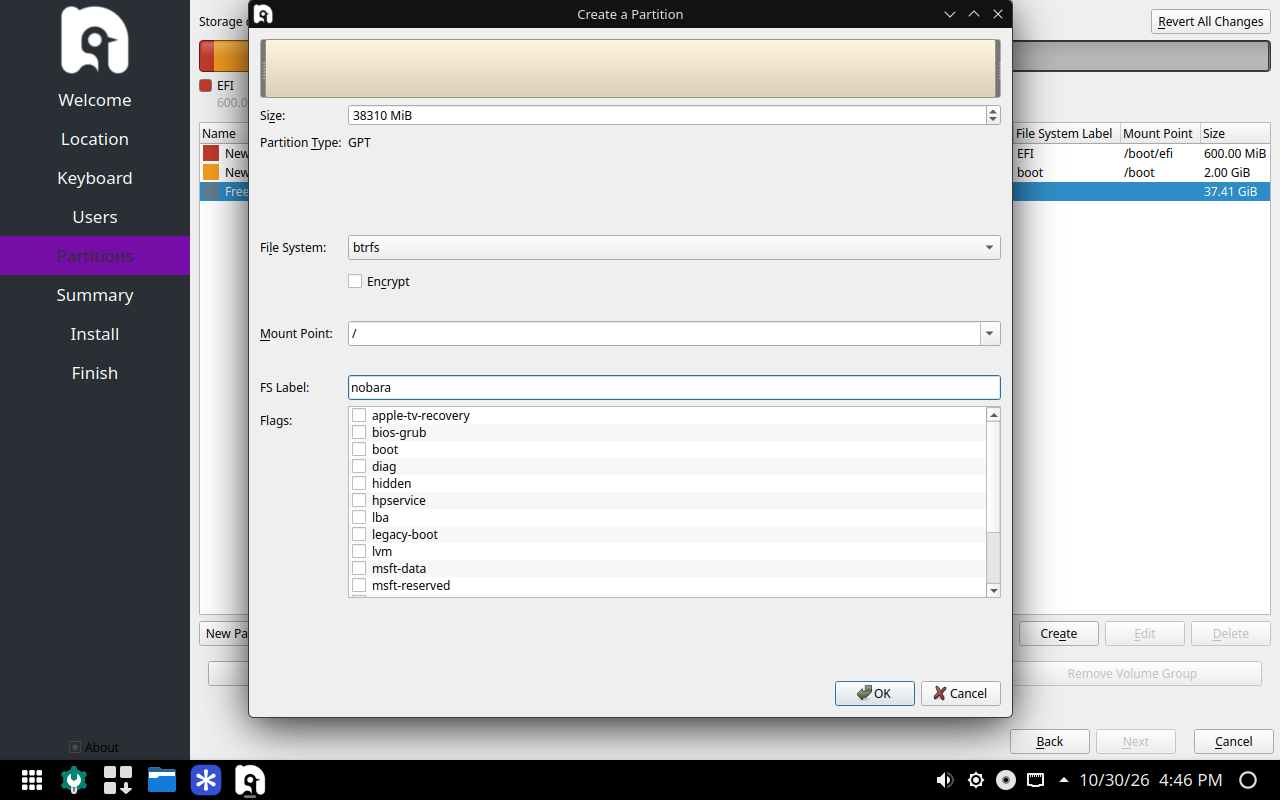
You don't need to create subvolumes or a /home partition. The installer
creates the @ (root) and @home subvolumes inside the Btrfs partition
automatically, which is the layout the updater's snapshots expect.
The finished layout:
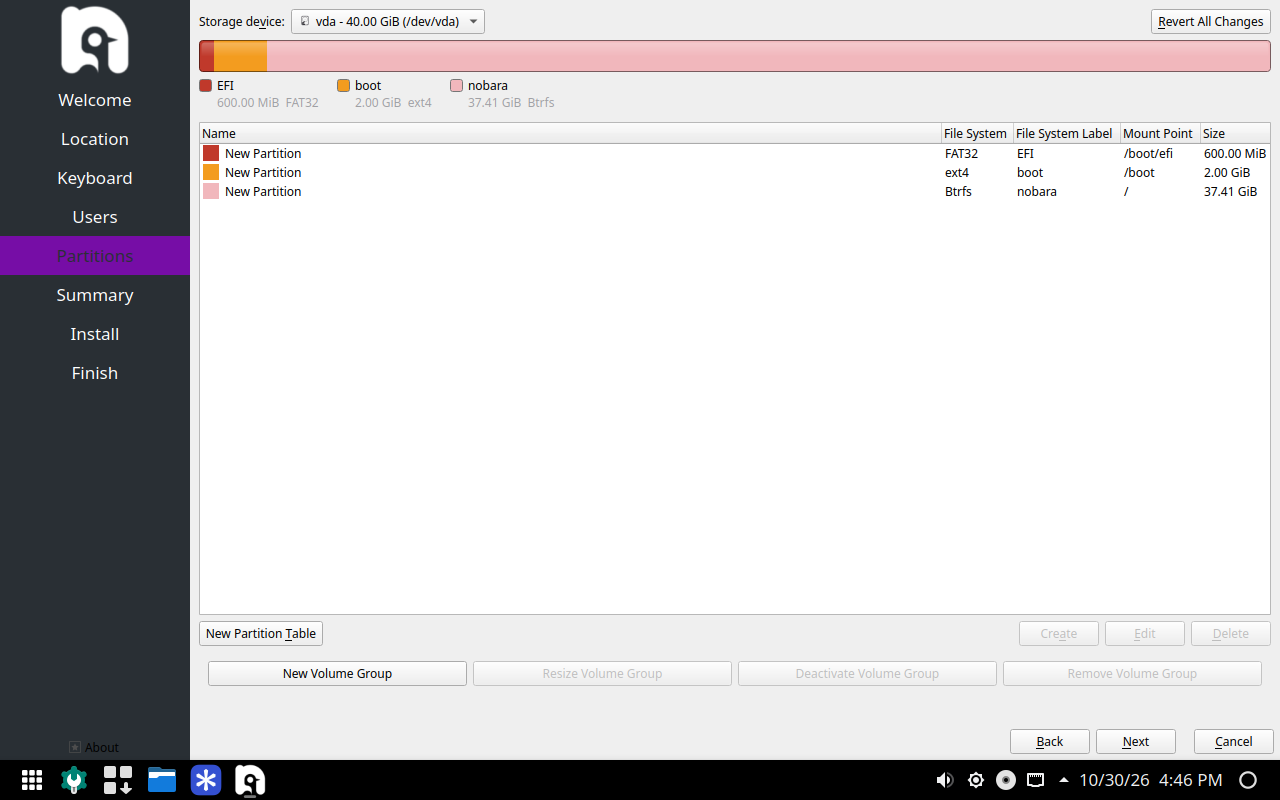
Click Next and check the Summary page. It should list a new 600 MiB
fat32 partition at /boot/efi, a 2048 MiB ext4 partition at /boot, and
"Install Nobara Linux on new btrfs system partition".
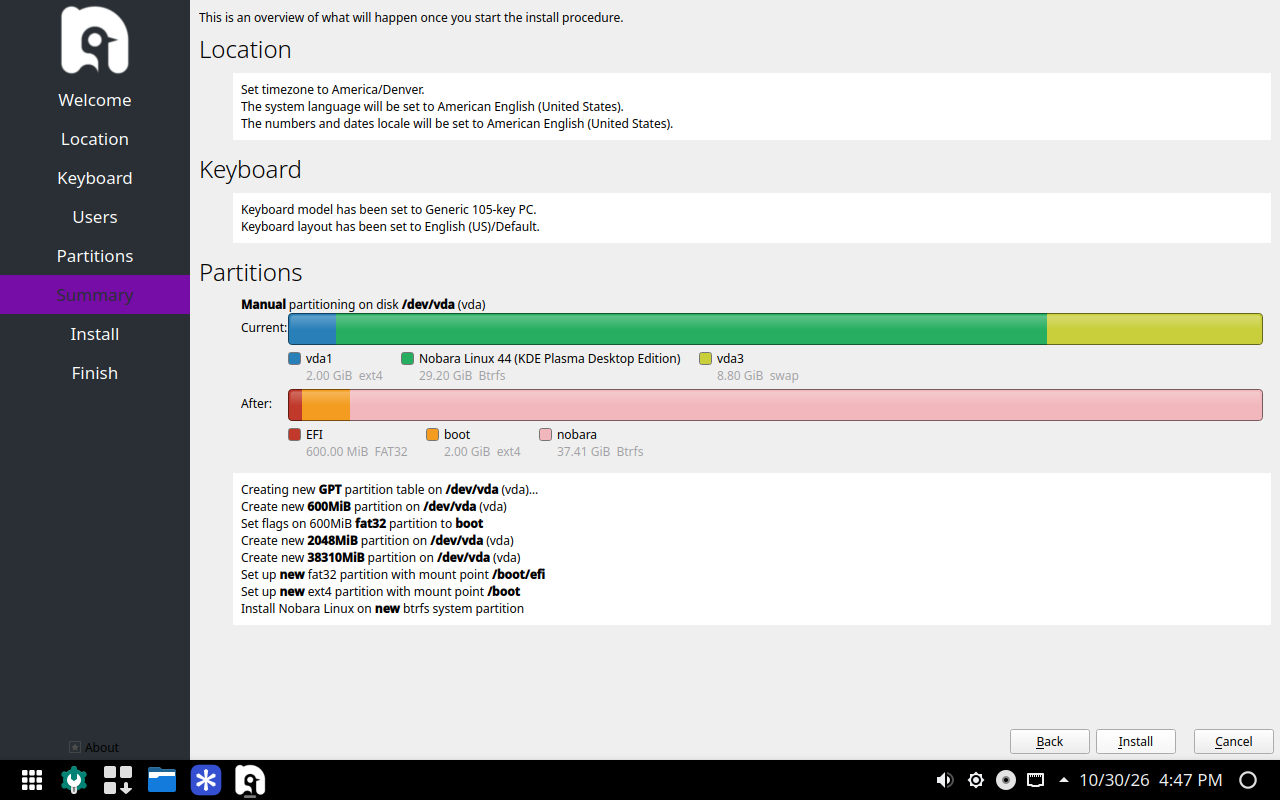
If it looks right, click Install.
¶ After installing
- The updater checks your layout each time it prepares a system update. If
rollback isn't available, the update still installs and the log says why
(for example, no separate/boot, or not enough free volume group space). - To check the free space on LVM later:
sudo vgs(look at VFree).